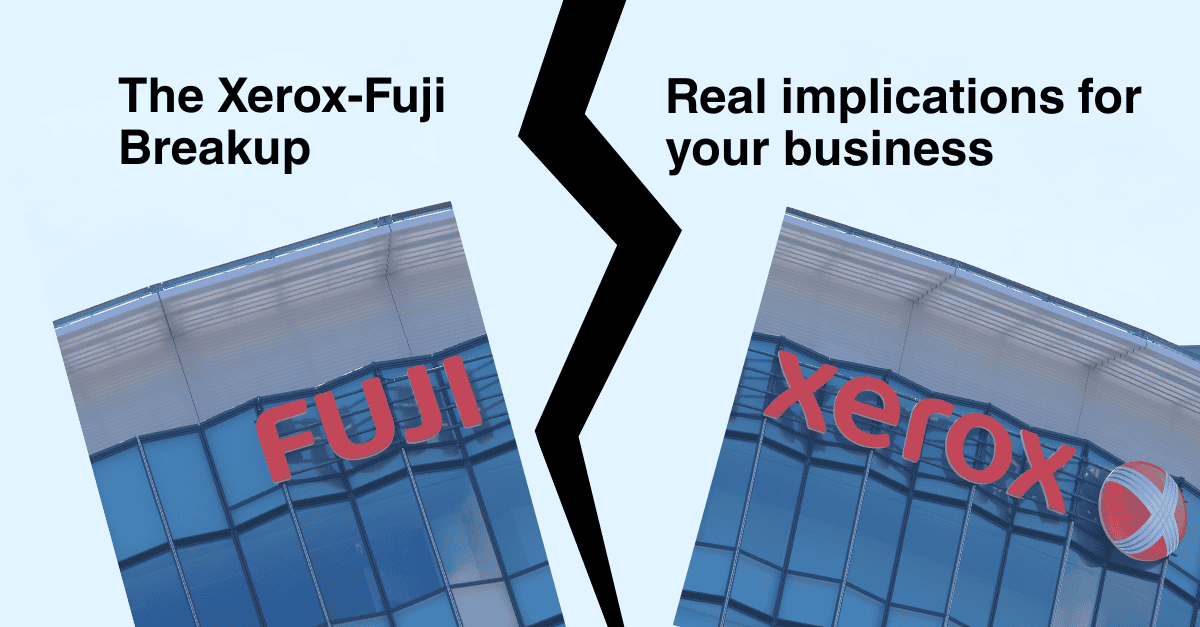
In our last blog, we talked about high level changes at Xerox – their business strategy, their technology, and their partnerships. Not to bash Xerox or to kick them when they’re down, but to inform customers about what’s changing behind the scenes and how those changes could impact their business now and over the next several years.
This is not about creating fear, but to encourage businesses to take a closer look before making a long term decision.
In this blog, we are going to dive a bit deeper into the relationship between Xerox and Fuji, how it’s changed, and what it means.
For years, customers stayed with Xerox because the equipment and its interface was familiar and reliable. When agreements came up, most customers upgraded and renewed. There was no need to shop around. The technology foundation, built on a partnership between Xerox and Fujifilm (who manufactured the devices) was consistent and the service experience was dependable. It was an easy decision.
That foundation is now gone. That longstanding partnership between Xerox and Fujifilm has ended.
- The platform you’ve relied on is being replaced
- Your next devices will come with a different hardware manufacturer altogether
- Xerox’s long-term commitment to print is increasingly unclear
In addition to the Xerox/Fujifilm hardware partnership ending, the relationship has become competitive. Fujifilm is now operating independently as Fujifilm Business Innovation and has developed its own products under its own brand. It’s already here in Canada. For the first time, Xerox is now competing against the same organization that has deep knowledge of the technology, the channel, and the customer base.
Xerox Is Rebuilding – Not Refining
Since the split, Xerox has been piecing together a new technology path, labeling it as “reinvention.” Xerox has:
- Partnered with Kyocera in inkjet
- Acquired Lexmark
- Expanded into reselling IT services, PCs, and other areas
It’s a myriad of multiple vendors, new platforms, and multiple new product lines, many of which are unproven in the enterprise and new to their ecosystem. This is not refining – it’s risk. And at that point, you may wonder if you are buying from a manufacturer or a company that is simply reselling a mix of other companies’ technologies.
The Biggest Disruption is in Core Office Printing
Core office print environments are critical to most day-to-day business operations – finance workflows, HR documentation, legal and compliance, operational printing – and this is exactly where the biggest change is happening. Xerox is moving toward Lexmark as part of its future core print technology strategy.
Lexmark is not traditionally known as a market leader in multifunction print technology. Their strength has been desktop printers, cost-focused .
That’s very different from what Xerox customers are used to. If the platform doesn’t perform the way your current environment does, the impact shows up as:
- Slower workflows
- User frustration
- Increased IT involvement
- Productivity loss
- Unproven reliability
Our customers have already told us that service has degraded – they are waiting longer and paying more, directly impacting users and productivity.
It’s Not Just Customers Who Are Questioning Xerox’s Future
What’s more concerning is what we’re hearing from inside the Xerox ecosystem itself.
In conversations I’ve had with Xerox dealers—people who sell, support, and depend on this technology every day—there’s a noticeable shift in confidence.
- Questions about the direction of the platform
- Uncertainty about how these changes will land with customers
- And in some cases, real concern about the long-term viability of Xerox itself
These aren’t outside opinions. When the people closest to the platform start questioning it, customers should pay attention.
You May Be Forced Into That Change Without Knowing It
At renewal, many businesses expect a like-for-like upgrade, but if Xerox is introducing a new platform, that’s not expected to be an option. In fact, customers may not even be fully informed or aware.
Renewal will mean dealing with changes you didn’t ask for – new hardware, and an unknown new service experience. In other words: You could be committing to a completely different environment—without realizing it.
This Isn’t About the Market—It’s About Xerox
Let’s be clear—this isn’t an industry-wide issue. There are manufacturers in this space—HP, Fujifilm, Konica Minolta, Brother —who are operating on stable platforms with clearly defined roadmaps that are investing and innovating.
For example, across the market right now:
- AI is being integrated into document workflows
- Devices are becoming smarter about routing, indexing, and automating tasks
- Security and compliance features are evolving alongside hybrid work environments
- Cloud integration is becoming more seamless and standardized
These aren’t experiments; they’re extensions of established platforms. That’s the difference.
While other manufacturers are advancing, Xerox is:
- Still redefining its core platform
- Replacing a long-standing hardware foundation with new pieces
- Introducing new systems customers haven’t used before
When you evaluate vendors, you’re not just buying a device. You’re committing to a platform, roadmap, and long-term experience. With most manufacturers that roadmap is clear, but with Xerox, it’s unknown.
What Does This Mean for You Now?
It means your next renewal isn’t routine. It’s a decision about:
- A changing platform
- A different hardware experience
- A vendor in transition
The biggest risk I see right now is simple: Customers assume they’re renewing what they already have. In reality, they may be locking into something very different.
At Digital Business Systems, we’ve worked with Xerox technology for over 20 years. We understand what customers expect from the platform because we’ve supported it, sold it, and built environments around it.
That’s exactly why we’re having these conversations now. From where we sit, the changes happening behind the scenes are significant, and they’re not always obvious during a standard renewal process.
If your Xerox agreement is coming up, this is the right time to re-evaluate before you re-sign. Digital Business Systems is helping Canadian organizations do exactly that.
An assessment from us will:
- Evaluate your current business requirements and workflows
- Identify risks and service gaps
- Uncover opportunities to reduce costs
- Compare alternative, proven platforms
- Align your strategy to your business – not a vendor in transition.
Final Thought
What would I do if I were in your shoes?
I’m not here to tell you to leave Xerox, but you do need to understand that the Xerox you built your environment around is not the same Xerox you’re evaluating today. If you don’t take the time to understand what’s changed, you may not realize the impact until after you’ve signed your next agreement.
If your renewal is coming up, don’t assume. Verify, ask questions, and get a second opinion. Understand your options before you commit.